When the Weights Stop Moving: The Plateau-Breaking Playbook
Every lifter meets the wall — the squat stuck at the same weight for a month, the progress graph gone flat — and the plateau is almost never a mystery: it’s a diagnosis with a checklist. The plateau-breaking playbook: the audit, the interventions and knowing when to just wait.

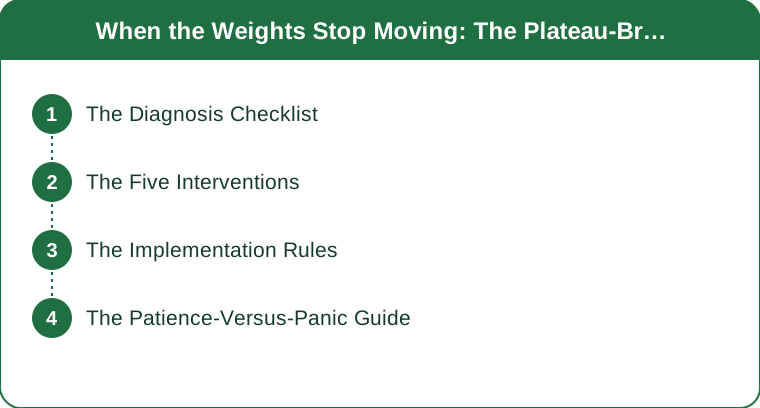
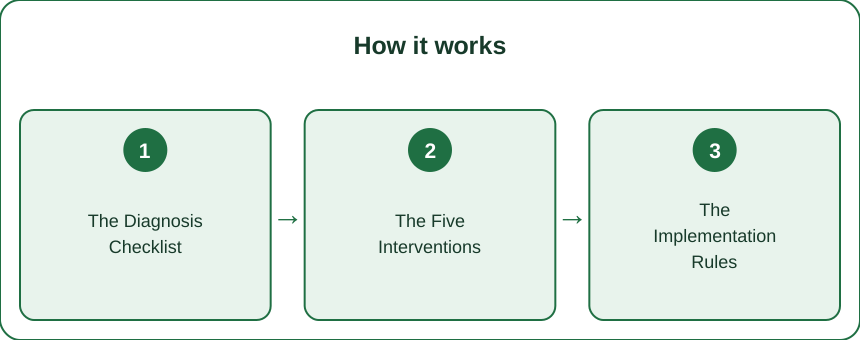
The Diagnosis Checklist
Auditing before intervening: the recovery audit first (the sleep, protein and stress check from the recovery chapters — the plateau that’s really a recovery deficit being the most common; the training that only signals what recovery builds), the log honesty (the actual-versus-remembered training reviewed — the ‘stuck for a month’ that’s really two sessions of half effort; the training log from the tracking doctrine as the evidence), the progression-scheme check (the program that stopped asking for more — the same-weights-same-reps comfort loop; the overload doctrine’s audit), the life-load context (the plateau during the brutal work season being physiology, not failure — the cortisol chapter’s math; the maintenance-is-victory frame for hard seasons), and the newbie-gains reality (the early linear progress ALWAYS ending — the plateau at month six being graduation, not breakdown; the expectations recalibrated to slower, earned gains).
The Five Interventions
The proven levers, in order: intervention one — the deload week (the planned easy week that resolves accumulated fatigue — the plateau that vanishes after rest being the most common outcome; the deload doctrine’s first-resort status), intervention two — the rep-range rotation (the 5s lifter moving to 8-12s for a block, or the reverse — the novel stimulus without program surgery; the same lifts, new demand), intervention three — the volume adjustment (the stuck lift given one extra weekly set-or-session — the dose raised carefully; OR the everything-hard lifter cutting volume: the more-is-better error audited), intervention four — the technique investment (the form review from the video-audit doctrine — the sticking point that’s a mechanics leak; the paused-and-tempo variants that fix positions; the coaching session as the shortcut), and intervention five — the variant swap (the flat bench to incline, the back squat to front squat for a block — the pattern kept, the exercise rotated; the return to the original with new capacity).

The Implementation Rules
Doing it right: the one-change law (a single intervention at a time — the everything-changed program that can’t attribute its results; the experiment doctrine from the tracking chapters), the block commitment (each intervention run four-six weeks before judgment — the two-session verdicts being noise; the patience window that lets adaptation show), the measurement honesty (the plateau’s end defined in advance — the rep PR, the load increase, the bar speed; the goalposts fixed before the experiment), the lift-specific focus (the stuck squat treated while the progressing press is left alone — the intervention targeted, not global), and the program-hopping warning (the plateau being the moment programs get abandoned — the intervention-within-the-program beating the restart-at-zero; the program-hopper’s permanent intermediate status from the consistency doctrine).
The Patience-Versus-Panic Guide
When to wait instead: the timeline calibration (the intermediate lifter’s progress measured monthly, the advanced lifter’s quarterly — the daily-PR era being over; the plateau that’s actually normal pacing), the maintenance seasons (the life chapters where holding strength IS the win — the busy-season doctrine; the plateau reframed as successful defense), the body-recomposition window (the scale-and-bar both flat while the mirror changes — the recomp reality from the body-composition chapters; the measurements beyond the barbell), the when-to-worry list (the strength DECLINING across a month, the everything-stalled-plus-exhausted pattern — the overtraining-or-health check from the relevant chapters; the doctor visit for the unexplained), and the long-game close (the plateau as strength training’s tuition — every lifter’s graph being stairs, not slopes; the wall met calmly, audited, and broken or waited out; both being wins). Audit recovery first, deload second, change ONE thing: the wall, playbooked.
Plateaus are diagnoses: audit recovery and your log first, then deload, rotate rep ranges, adjust volume, fix technique or swap variants — ONE change per four-week block. Stairs, not slopes.
Keep Reading
This article is for general informational and styling purposes only. Fit, sizing, and product availability may vary.